
Power Switching Devices - Relays
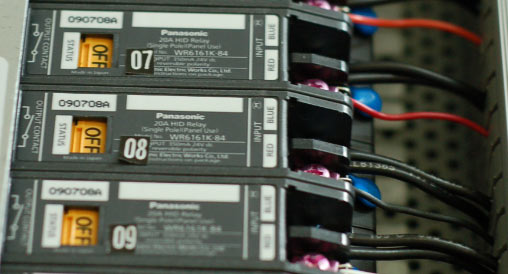
The WR-6161 is a magnetic latching relay. When it receives a momentary polarized pulse from a two-wire relay control system, it provides a permanent On/Off control of lighting and other electrical loads. Its state remains until the coil is re-magnetized.
WR-6161 is a Single pole 20 Amp High-In-Rush-Duty Relay
WR-6166 is a Double pole 20 Amp High-In-Rush-Duty Relay
| Electrical Inputs (Low Voltage) | ± 24 VDC, rectified half-waves, reverse polarity. Class II, 350 mA current |
| Electrical Outputs (Line Voltage) | – Resistive load: 20 A, 347 Vac – Inductive load: 20 A, 347 Vac – Incandescent lamp: 20 A, 120 Vac – Fluorescent lamp: 20 A, 347 Vac – H.I.D Lamp: 20 A, 347 Vac – Motor: 1-1/2 HP at 220-277 Vac (general use). – Motor: 1/2 HP at 120 Vac (tungsten) |
| Operation | – A positive pulse of 18 to 30 Vdc opens the relay and disables the load (Off action)
– A negative pulse of -18 to –30 Vdc closes the relay and enables the load (On action) |
| Test condition | – Reliable contact opening mechanism for 60,000+ On/Off cycles on a full 20 A HID charge at 347 Vac (20 times/minute switching cycle)
– High in-rush duty (HID) : Flawless operation up to 1,500 A for 20 milliseconds – Ambient temperature: -30° C to 50° C |
| Override switch | Manual On/Off operation lever (integral to the relay) |
| Status indicator | Visual mechanical indicator of status (On or Off) |
| Wiring | Two-wire for both pulse activation and state return command for automatic monitoring through a control panel indicator lamp or a host PC |
| Mounting | Adapter mounted for easy removal. Mounts on WR-9910 Mounting Strap. |
| Auxiliary contact (optional) |
0.5 A, 125 Vac |
| Weight in lb (kg) | 0.437 (0.198) |
| Certification | – Underwriters Laboratories (UL) listed
– CSA |
